
Why the fence goes weak in winter, and why it is not the energizer
Frozen soil breaks the return half of an electric fence circuit. How much ground rod you need per joule, why never copper, and what to fix before freeze-up.
HornCore earns affiliate commission on some pages. There are no affiliate links on this one.
The fence tested fine in October. In January a cow walks through it. The energizer is the same energizer, the wire is the same wire, and nothing on the fence line has changed.
What changed is underneath it.
The half of the circuit nobody maintains
An electric fence is not a wire, it is a loop. The energizer pushes a pulse down the hot wire. An animal touching that wire gives the pulse a path to earth. The pulse then has to travel back through the soil to the ground rods and into the energizer's earth terminal. No return, no shock — and the animal feels a fraction of whatever the meter on the wire is telling you.
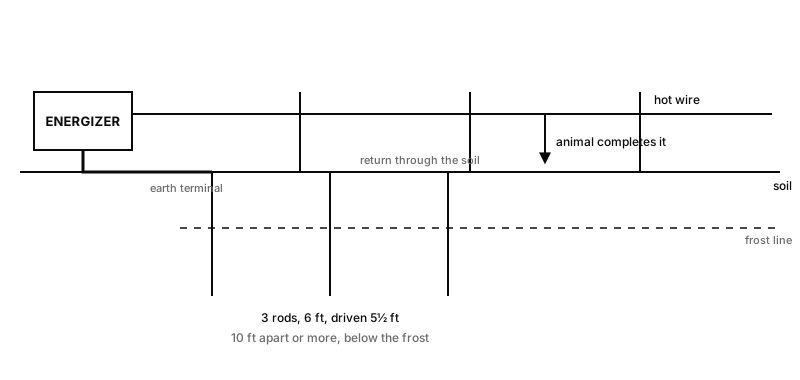
Soil conducts because it is damp. When that moisture freezes, resistivity rises sharply, and the return path you built in July stops working in the weather you actually needed it for. Dry sand does the same thing all year. Frost just does it to everybody at once.
How much rod you actually need
The rule worth remembering is three feet of ground rod per joule of energizer output. Published guidance puts that at a minimum of three rods driven six feet for energizers up to 15 joules, five rods up to 25, and seven up to 35, adding another rod for every eight joules beyond that.
Then the soil multiplies it. Wet loam or moist clay is roughly one rod per joule. Dry loam is about one and a half. Dry sand is three, because sand is closer to an insulator than a conductor.
Most fences that go weak are not under-powered. They are under-grounded, and on a fence tester the two look identical.
The specifics that are easy to get wrong
- Not copper. Use 5/8-inch galvanised steel rod, or 3/4-inch galvanised pipe. Copper against galvanised wire and clamps sets up galvanic corrosion, and the joint you cannot see is the one that fails.
- Ten feet apart, minimum. Rods closer than that draw on the same volume of soil, and the third one ends up doing the work of about half a rod.
- Deep enough to be under the frost. Six-foot rods driven five and a half feet is the usual figure. Where frost reaches past four feet, the rod has to go past it too, or the whole system spends winter sitting in the frozen layer.
- Placement matters in winter. Undisturbed snow insulates the ground beneath it. A rod bank on the leeward side of a building, or under trees where the snow lies untrampled, sees less frost than one out in a scoured, wind-blown corner.
What to do before the ground hardens
- Read the fence at the far end, not at the energizer. The energizer is not the thing under suspicion.
- Count your rods against your joules, then against your soil type. Add rod before you add energizer. It is cheaper, and it is more often the actual problem.
- Soak the ground around the rod bank before freeze-up. Damp soil that then freezes still beats dry soil that freezes.
- Check every clamp. Galvanised to galvanised, tight, and no copper anywhere in it.
- If you are on sand, rock or deep frost, look at a ground-return system instead — an earth wire run on the fence itself, so the pulse never has to rely on the soil.
What we are testing this winter
Energizers on the same fence and the same rod bank, read at the far corner through a real winter, with soil temperature written down beside the voltage. Where we have not tested something, the page will say so before you read a word of it.
Sources
Grounding and energizer sizing from Virginia Cooperative Extension and Premier1 Supplies. Winter conductivity guidance from the British Columbia Ministry of Agriculture. These figures are a starting point for your own fence, not a substitute for reading it.
No comments yet. Login to start a new discussion Start a new discussion